
Playful experimental musings dealing with light and composition. The sharp geometric lines give volume and perspective.
Playful experimental musings dealing with light and composition. The sharp geometric lines give volume and perspective.

This is a test post before I get back into the swing of things.
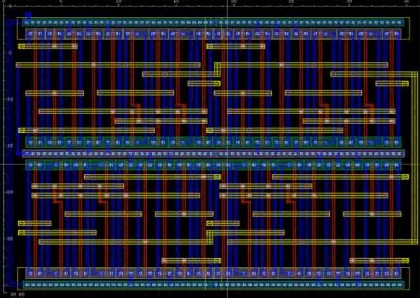
The objective of this report is to design a parallel 4-bit adder for low power consumption using 0.18 micron technology. The transmission gate implementation of the 4-bit ripple carry adder is chosen. Implementation is based on a bottom-up design methodology from schematic design of individual devices to integration. Critical paths are abstracted and optimized for low power dissipation. The schematic design is translated into prefabrication layout. Simulation of the schematic and layout realizations of the adder is performed and results are discussed. Performance is validated with specifications imposed by the target application.
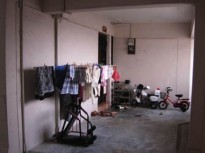
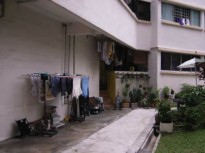
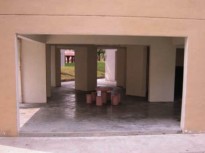
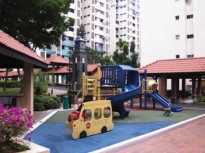
The Singaporean government faces a new challenge to accommodate rising demand for public housing but also strive to retain the nuances from the past. The following architectural study shall investigate whether there is a correlation between daily activities held within the premises of a typical apartment complex in relation to morale as found in traditional Kampung ways.
Inbuilding RF solutions provide targeted coverage and capacity relief to specific areas which otherwise cannot be covered by the outdoor macro network. I have worked on numerous high-profile inbuilding solutions, one of which is documented below. I was the prime RF designer for this project from start to finish. This project had undergone accelerated build to meet an event deadline and was commissioned within one month of project initiation. A very brief overview of the project is abstracted below for your perusal. Please note that project identifiers have been changed and this abstract gives a glimpse of the extent of my activities.
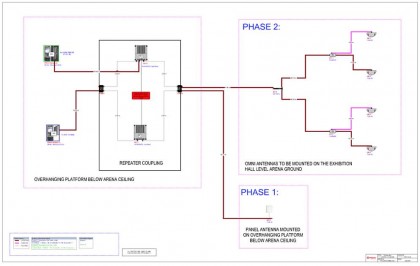
XYZ Coliseum is a large indoor stadium in Ontario, Canada. Project requirements were to improve inbuilding coverage before ABC event being held over the period of Mar 3rd to 11th, 2007. The project was initiated on February 8th, 2007 which left very little time for construction. Kick-off meeting was held on site with RF Engineering, represented by myself, along with Civil Engineering, Optimization, Sales, and Client to address the scope of work and possible methods for implementation. Based on discussion from the site visit and RSSI measurements, I performed an extensive RF study of the macro network and analyzed the link budget and pathloss for proper positioning of antennas. I designed the coupling and layout plan. Design margin was also accounted for in case of changes to the scope of work. I had specified the equipment costs as part of the project budget and had submitted to Planning and management for approval. At this stage, the project was evaluated for its business case.
The objective of this assignment was to observe the severity of change in the RF network between an unoptimized yet lightly loaded network in comparison to the same network with eight times the traffic. Live GSM traffic was collected from the BSC and assumed to be the baseline for initial WCDMA/HSPA traffic.
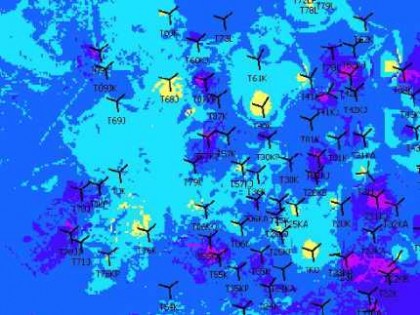
The live traffic was also asserted to Monte Carlo distribution for enhanced accuracy for predicted WCDMA/HSPA performance. The predictions use a mix of tuned and theoretical models. The assignment does not make any recommendations on optimization but clearly identifies the severity of change between an unloaded versus loaded network. Project identifiers, constants, and other details are censored and the attachment simply gives a basic idea of the rationale behind the analysis.
Web merchandising and marketing effectiveness is evaluated by observing clickstream data and corresponding microconversion rates. Parallel coordinates and starfield visualization of consumer data is studied. Merchandising cues such as cross-sells, up-sells, recommendations, and promotions are described along with marketing clickthrough and conversion rates to gauge site performance.


Prior to applying to business school, I took a stab at the prestigious MIT Media Labs. Although it didn’t work out, the process was an enlightening one. In brief, before Internet of Things became all the rage and the term coined, I’ve always thought that near limitless bandwidth was an inevitability and that we would be limited merely by imagination constraining our abilities to exploit such medium. I foresee the network behaving like a global nervous system. There are widespread sensors acting like inputs that span across cities while the output mechanisms improve our effectiveness as a community, from optimizing traffic lights in real-time to rapidly monitoring the spread of diseases. We will also benefit from more vivid long distance communication possibly harnessing physical media to establish a greater sense of connection. The world can be viewed as it happens, in real-time, in extreme detail.
Application
MIT Media Labs Grad Application